

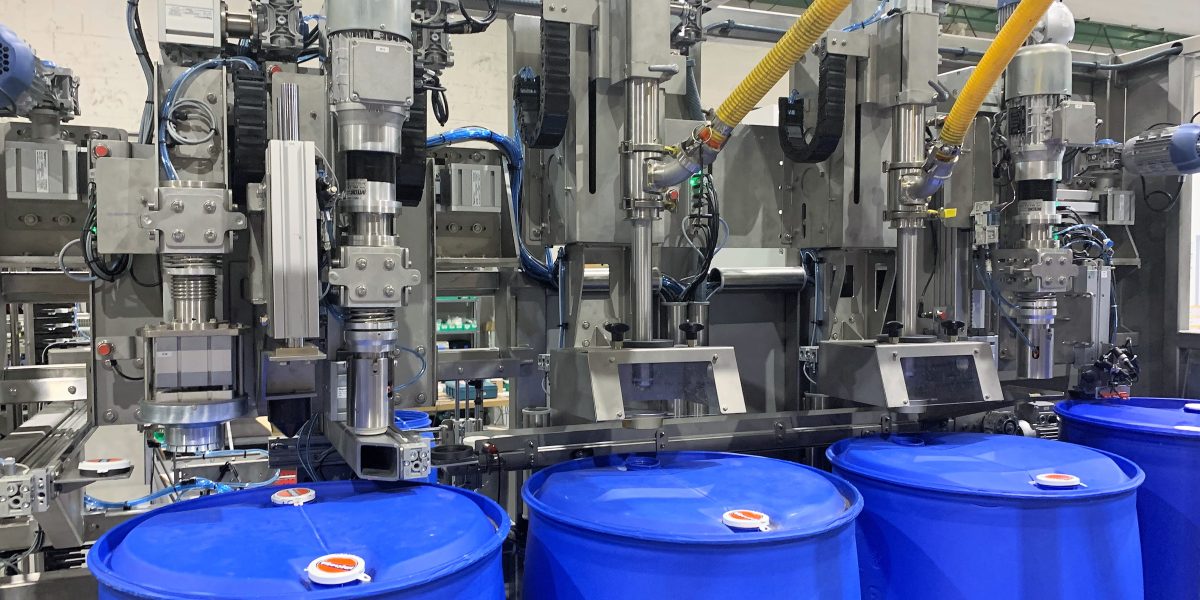
In the vast warehouses and production facilities that define Singapore’s industrial landscape, a drum filling machine represents far more than a simple piece of equipment. It is, in many respects, the invisible architecture upon which modern manufacturing depends, quietly determining whether a chemical plant meets its quotas or a food processing facility maintains the exacting standards that keep shelves stocked and consumers satisfied.
The Mechanics Behind Precision
Walk into any chemical processing facility in Singapore’s Jurong Industrial Estate, and you will likely encounter the steady rhythm of automated filling systems. These machines operate on a principle that sounds deceptively straightforward: fill a container to a precise weight or volume, then move to the next. Yet the engineering required to achieve this consistently, across thousands of drums each day, involves a sophistication that belies the simplicity of the task.
Modern drum filling machine employ gravimetric technology, which monitors weight in real-time as liquids flow into containers ranging from 50 to 300 litres. The filling process typically occurs in two stages: a rapid coarse fill followed by a slower fine fill that ensures accuracy within tolerances of 0.1 per cent. This two-stage approach prevents the overfilling that would waste expensive materials and the underfilling that would breach regulatory requirements.
Applications Across Singapore’s Industries
The versatility of industrial drum filling equipment becomes apparent when one considers the range of materials these systems must accommodate. In Singapore’s chemical sector, filling machines handle everything from highly viscous petrochemicals to volatile solvents that demand explosion-proof designs compliant with ATEX standards. The pharmaceutical industry requires systems capable of maintaining sterile conditions whilst achieving pharmaceutical-grade precision. Food manufacturers filling edible oils need equipment constructed from food-grade stainless steel that can be thoroughly cleaned between product runs.
According to suppliers operating in Singapore’s industrial zones, semi-automatic and fully automatic filling systems are available in configurations suited to different production scales. These systems offer top fill and bottom-up fill configurations, with the latter particularly valuable for foaming liquids that require subsurface filling. The choice between configurations often determines whether a manufacturer can economically package certain products at all.
Key Advantages of Automated Systems
The transition from manual filling to automated barrel filling systems delivers benefits that extend well beyond simple labour savings:
• Enhanced safety protocols
Automated systems minimise human contact with hazardous materials, reducing exposure to toxic chemicals, flammable liquids, and corrosive substances that characterise many industrial products.
• Regulatory compliance
Precise weight-based filling ensures products meet legal requirements for quantity declarations, a consideration of particular importance in Singapore’s strictly regulated market.
• Reduced product loss
The accuracy of modern liquid filling systems eliminates the spillage and measurement errors that plague manual operations, a factor that becomes economically significant when filling expensive specialised chemicals.
• Improved throughput
Whilst semi-automatic systems require operator intervention for drum positioning and capping, fully automatic lines can process up to 40 drums per hour with minimal human oversight.
Semi-Automatic Versus Fully Automatic Systems
The distinction between semi-automatic and automatic drum fillers reflects not merely a difference in automation level but a fundamental divergence in operational philosophy. Semi-automatic systems suit manufacturers with moderate production volumes or frequent product changeovers. These machines typically require operators to position empty drums, initiate the filling cycle, and cap filled containers manually. The trade-off for this labour involvement is flexibility and a significantly lower capital investment.
Fully automatic filling lines, by contrast, integrate drum conveyance, positioning, filling, capping, and even palletising into a continuous automated process. Such systems make economic sense only for manufacturers with consistent high-volume requirements, yet for those operations, the efficiency gains prove transformative. Singapore-based suppliers note that complete systems combining filling equipment with conveyor and palletising technologies enable fully automated packaging processes.
Safety Considerations in Hazardous Environments
Singapore’s regulatory framework, enforced by agencies including the Ministry of Manpower, mandates stringent safety provisions for facilities handling flammable or explosive materials. Drum filling machinery designed for these environments must incorporate multiple layers of protection: explosion-proof electrical components, nitrogen inerting systems that displace oxygen during filling, automatic shutoff mechanisms that prevent overfilling, and containment features that capture any spillage.
The cost of explosion-proof drum fillers exceeds that of standard equipment by a considerable margin, yet for facilities handling volatile solvents, varnishes, or petrochemicals, this investment proves non-negotiable. The alternative, quite simply, is unacceptable risk.
Selecting the Right System
Choosing appropriate filling equipment requires careful evaluation of several factors: the physical properties of products being filled, required production capacity, available floor space, budget constraints, and long-term operational plans. A facility filling only viscous lubricants faces different challenges than one handling thin, foaming liquids or food-grade materials requiring sanitary design.
The drum filling machine that serves a manufacturer well today must also adapt to tomorrow’s requirements, making flexibility a consideration equal in importance to current specifications.
